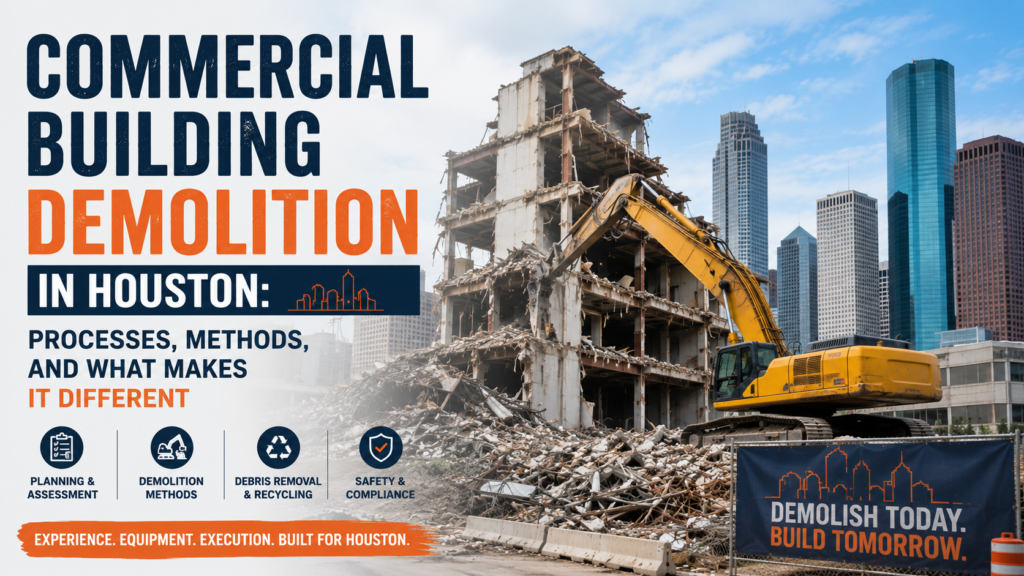
Houston’s skyline and commercial landscape are in a state of constant reinvention. Office towers in the Energy Corridor get repositioned, retail centers in Sugar Land are replaced with mixed-use developments, aging warehouses along the Ship Channel make way for modern logistics facilities, and storm-damaged commercial properties are cleared for insurance-driven rebuilds. Driving all of this transition is Commercial Building Demolition Houston a discipline that is more complex, more regulated, and more strategically demanding than residential work.
For anyone involved in Houston’s commercial real estate or construction sectors, understanding what commercial demolition actually entails is valuable background knowledge.
What Sets Commercial Demolition Apart
Commercial demolition encompasses the planned dismantling or removal of buildings used for business purposes. This includes retail outlets, office buildings, warehouses, industrial facilities, restaurants, shopping centers, hospitals, and any other structure that is not primarily residential. The defining characteristic of commercial work is its scale and complexity commercial buildings are typically larger, built with more robust materials, and integrated with more extensive utility and mechanical systems than residential structures.
The stakes are also higher. Commercial demolition often takes place in dense urban environments where neighboring businesses remain in operation, pedestrians move through nearby areas, and traffic continues on adjacent streets. Managing those realities while safely bringing down a substantial structure demands detailed planning, specialized equipment, and experienced project management.
Types of Commercial Demolition
Full structural demolition involves the complete removal of a commercial building. This may be driven by redevelopment plans, fire or storm damage, building code violations, or simple obsolescence. The goal is to clear the site entirely so new construction can begin on a clean slate.
Selective demolition removes only specified portions of a commercial building while leaving the rest standing and operational. This is common in renovation and tenant improvement projects, where a business wants to reconfigure interior spaces, update mechanical systems, or expand certain sections without losing the entire structure. Selective work requires careful structural analysis to ensure that removing one section does not compromise the integrity of what remains.
Interior strip-out or gut demolition removes all interior elements partitions, ceilings, flooring, mechanical systems while preserving the exterior shell. This is often the first step in a complete commercial renovation, transforming an older building’s interior for modern use while retaining the outer structure.
Industrial demolition occupies its own specialized category. Factories, refineries, power plants, and large-scale processing facilities present unique challenges: hazardous materials may be embedded in systems and surfaces, structural configurations differ significantly from conventional buildings, and environmental compliance requirements are more stringent.
Methods Used in Commercial Demolition
Excavator-based mechanical demolition is the most common approach for small to mid-sized commercial structures in Houston. Modern excavators can be fitted with a variety of attachments shears, crushers, pulverizers, and standard buckets that allow operators to systematically break down a building, floor by floor, from the top down. This method offers good control over the direction and pace of demolition and works efficiently in relatively confined urban sites.
Wrecking ball demolition, while less common than it once was, remains a viable option for certain large-scale projects. A multi-ton steel ball suspended from a crane is swung against a structure’s base to destabilize and collapse it. The method requires considerable open space around the target structure and skilled operation, making it better suited to less constrained sites.
Dismantling involves carefully taking a structure apart piece by piece using cutting tools and cranes. This method is preferred when specific materials are to be salvaged for reuse or recycling, or when only a portion of the building needs to go. Dismantling is slower but produces less collateral damage to surrounding areas and maximizes material recovery.
Explosive demolition the dramatic implosion seen in viral videos is reserved for a small fraction of projects, typically very large structures in open enough areas to accommodate controlled collapse. The process requires extensive engineering, regulatory approvals, and precise placement of explosives to bring the structure straight down without damaging adjacent buildings. Houston has seen this method used for large structures that could not be efficiently demolished by other means.
The Houston Permitting Process for Commercial Demolition
The City of Houston requires a demolition permit before any commercial structure can come down. The process mirrors the residential permit process in its requirements: a licensed master plumber must first purchase a plumbing permit to disconnect all sewer and water lines, complete that work, and have it inspected and approved before the demolition permit application can even be submitted.
The permit application includes a building permit application form and, where applicable, an asbestos survey. Demolition of high-rise buildings requires additional review the Building Official must personally approve those projects. Once permits are secured, a final demolition inspection is required after the building has been removed, using the City’s Interactive Voice Response system to schedule. Permits must remain on site throughout.
Hazardous Materials in Commercial Buildings
Older commercial buildings in Houston frequently contain materials that require special handling before demolition can proceed. Asbestos was widely used in commercial construction through the 1980s in floor tiles, ceiling tiles, pipe insulation, fireproofing, joint compounds, and roofing materials. Lead-based paint appears in structures built before 1978. PCBs may be present in older electrical equipment. Mold can develop in buildings that have experienced water intrusion.
Federal and Texas state regulations require that these materials be identified through a professional survey and removed by certified abatement contractors before demolition begins. The EPA’s National Emission Standards for Hazardous Air Pollutants (NESHAP) establishes specific requirements for asbestos handling during demolition. Violations carry significant penalties, making certified abatement not just an ethical responsibility but a legal one.
Environmental Practices in Commercial Demolition
Commercial demolition generates enormous quantities of material. The construction and demolition waste stream in the United States is one of the largest categories of solid waste, and Houston’s active commercial market contributes significantly to regional figures.
Responsible demolition contractors in Houston increasingly incorporate material recovery into their project planning. Structural steel an abundant component in commercial buildings is highly recyclable and typically captured for reprocessing. Concrete can be crushed on site and repurposed as aggregate for road base and other applications. Clean wood, copper, and aluminum are also commonly diverted from landfills through recycling. In some cases, fixtures, doors, windows, and architectural elements are donated to salvage organizations or resold, extending their useful life.
Safety and Compliance
Commercial demolition sites are among the most hazard-rich environments in any city. Falling materials, swinging equipment, ground-level debris, exposure to airborne particles, and proximity to active utility lines all create risks that must be systematically managed. OSHA regulations establish the safety framework for demolition work, covering everything from fall protection requirements to equipment operation protocols and air quality monitoring.
Experienced demolition contractors in Houston coordinate with county agencies covering public health, wastewater management, erosion control, and in certain cases, landmark preservation particularly when work takes place near historically significant structures. The breadth of regulatory compliance required reflects both the complexity of commercial demolition and the importance of doing it right in a city as large and active as Houston.
Houston’s Commercial Landscape and Demolition
Houston’s decentralized, sprawling commercial geography from the downtown business district to the Galleria area, the Greenway Plaza corridor, Westheimer’s retail strip, and the industrial zones surrounding the Ship Channel means that commercial demolition takes place in widely varying contexts. A project in a dense urban core presents very different challenges than one on an open industrial parcel.
Understanding the type, scale, and specific location of a demolition project is the starting point for any competent commercial demolition contractor. The combination of Houston’s regulatory environment, its unique soil and climate conditions, and the constant evolution of its commercial real estate market makes commercial building demolition here a specialized discipline that sits at the intersection of engineering, logistics, environmental compliance, and urban management.